

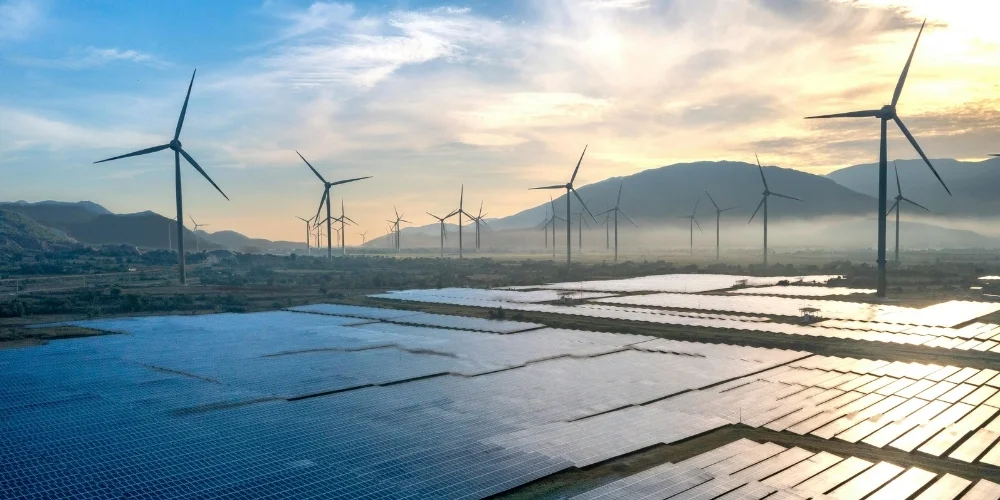
Renewable energy targets are gaining momentum; storage projects are moving to execution, nuclear commissioning timelines are becoming clearer, and green hydrogen is shifting from an “option” to a “requirement” under industrial and export pressure. Globally, continuity in the lithium battery supply chain is becoming even more critical. We compiled the key recent highlights—together with their real-world impact on the ground.
The 120 GW Journey
Türkiye’s installed electricity capacity reached 123,284 MW by the end of January 2026; combined solar + wind capacity hit 40,689 MW, accounting for 33% of total installed capacity. The overall share of renewable sources reached 62.5%.
This picture brings the 120 GW by 2035 target into the “achievable scale” category, while making the second act of the game more visible: grid capacity, connection infrastructure, the inverter ecosystem, and integration capability. Because as capacity grows, the system’s real test shifts from generation to transmission and balancing.
The global innovation agenda confirms the same inflection point. In the IEA’s “The State of Energy Innovation 2026” summary, 80% of experts and practitioners place energy security among the top three drivers of innovation. SHURA Energy Transition Center Director Alkım Bağ describes the path to 120 GW more concretely: “Over the next 10 years, an average of 8 GW of new capacity must come online each year; this requires not only investment appetite, but also permitting processes, grid connections, financing structures, and market design to work in sync.”
Another signal strengthening this framework comes from the financing side: the World Bank package being brought onto the agenda for grid modernization is designed especially to be used in high-voltage transmission (HVDC) investments that will support renewable targets.
In short: “120 GW” is no longer just a capacity target; it is a system transformation where equipment, engineering, grid, and finance advance in the same rhythm.
Energy Storage: 2026 Is the Year Projects Hit the Ground
For Türkiye’s energy storage ecosystem, 2026 is a turning point. Alongside 33,000 MW of hybrid capacity allocations, 6,000–7,000 MW of standalone storage projects are expected to move into physical construction during the year. These figures are the clearest proof that the sector is moving from discussion tables to concrete foundations.
The real meaning of the shift lies not only in project size, but in a change of function. As battery-supported solar and wind plants come online, storage systems move beyond the “backup capacity” role and become a critical operational player for grid flexibility applications such as ancillary services, peak shaving, and frequency regulation.
This new reality is creating a different competitive dynamic for both domestic manufacturers and international suppliersnot only in BESS, BMS, and EMS solutions, but also in grid integration technologies. The window is open for those who want to take their place in the sector—but time is tightening.
As Battery Scale Grows, “Supply Risk” Is on the Agenda
The global lithium-ion battery market exceeded USD 150 billion in 2025 and grew 20% versus 2024. On the demand side, the weight is still in electric vehicles (70%), but battery storage for grid flexibility is also growing rapidly with a 15% share. While falling prices accelerate scaling, the high concentration of the supply chain in certain countries is pushing the balance between cost advantage and supply security into a more strategic agenda.
Nuclear: Commissioning Agenda and International Collaborations
The nuclear agenda has moved from “plan” pages to “timeline” lines. The fact that 2026 is being cited as the commissioning year for Akkuyu NPP’s first unit naturally shifts focus toward connection infrastructure, compliance, services, and supply chain topics. The 20 GW nuclear capacity target by 2050 turns SMRs, EPC capability, and engineering consultancy into strategic priorities alongside large-scale plants.
In this framework, international engagements are also taking a more concrete form: under a protocol signed in Seoul in February 2026, discussions were held with KEPCO across areas such as nuclear power plant projects, SMRs, and battery technologies. In early March 2026, a Memorandum of Understanding was signed between AtkinsRéalis and TÜNAŞ on the applicability of CANDU reactor technology in Türkiye. At the Nuclear Energy Summit held in Paris on March 10, 2026 under the auspices of the IAEA, a joint declaration by industry organizations—including Türkiye’s Nuclear Industry Association—supporting the goal of tripling global nuclear capacity by 2050 has once again elevated nuclear’s position in the energy security + decarbonization equation.
Green Hydrogen: Concrete Preparation in OIZs, a New Phase Under CBAM Pressure
Green hydrogen is not staying on hold under the “future technology” label; the industrial and export equation is accelerating this topic. OIZ-scale steps toward R&D/production centers and developments around the electrolyzer ecosystem are finding faster traction—especially in heavy industry—under mechanisms such as CBAM, which comes into effect in 2026.
On the global side, test programs around fuel cell options and liquid (cryogenic) hydrogen systems indicate that the distance between “pilot” and “scaling” is shrinking. In this phase, differentiation will favor those who can build the right partnerships across electrolyzers, fuel cells, compression/storage, and safety infrastructure.
Track All These Topics on One Platform: ICCI 2027
To stay updated regarding renewable energy, energy storage, grid equipment, the nuclear ecosystem, and green hydrogen and meet decision makers, manufacturers, EPCs, and solution providers in one place, meet us at the 30th ICCI International Energy and Environment Fair and Conference on 20–22 January 2027 at Yenikapı Eurasia Show and Art Center, where you can compare solutions on site, evaluate the full ecosystem under one roof, and plan your visit now.